
Ebooks › Business & Compliance › Business Startup Handbook
The Complete Business Startup Handbook How to start a business legally in India
Registrations, licenses, permits, taxation and compliance explained step by step, for first-time entrepreneurs, startups and small business owners.
- GST
- Udyam / MSME
- Startup India
- Private Limited and LLP
- FSSAI
- Income Tax and TDS
- Instant download, no shipping
- Secure SuperProfile checkout
- PDF for mobile and desktop
- Updated for GST 2.0 and Income-tax Act, 2025
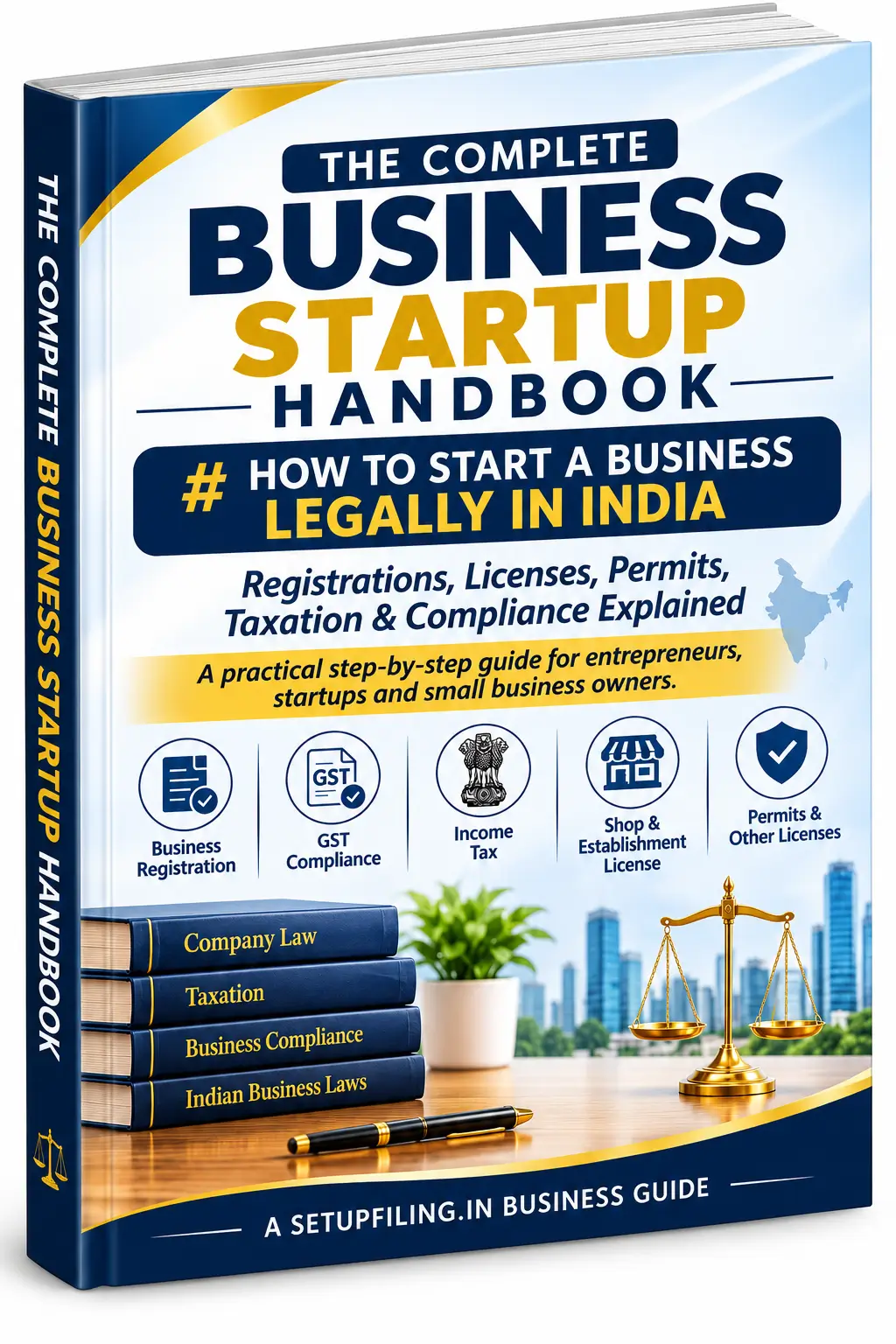
What is The Complete Business Startup Handbook?
It is a practical PDF guide by SetupFiling.in that explains how to start and run a business legally in India: which structure to choose, which registrations and licenses apply to your activity, how GST and income tax work, and which filings you must keep up with after launch. It is written in plain language for readers with no prior knowledge of company law or taxation.
What is inside the ebook?
Six parts that follow your journey, in order, from the first idea to a running and compliant business.
-
1Chapters 1 to 5
Understanding business setup in India
Planning and costs, choosing between proprietorship, partnership, LLP, Private Limited and OPC, and protecting your name and brand.
-
2Chapters 6 to 12
Business registration and legal formalities
How each structure is registered, plus Startup India (DPIIT) recognition and Udyam (MSME) registration.
-
3Chapters 13 to 21
Licenses and permits
GST, Shops and Establishments, trade license, FSSAI, Import Export Code, professional tax, factory and pollution approvals.
-
4Chapters 22 to 28
Taxation and financial compliance
GST rates and returns, income tax by structure, TDS and TCS, bookkeeping, banking and invoicing.
-
5Chapters 29 to 34
Ongoing statutory compliance
Annual filings for companies and LLPs, labour laws, PF and ESI, agreements, intellectual property and closure.
-
6Chapters 35 to 40
Practical startup toolkit
Master checklists, document lists, a cost guide, a compliance calendar, common mistakes and a 30-day launch plan.
Why entrepreneurs choose this handbook
Built to be used, not just read.
-
Plain language
Every technical term is explained when it first appears. No law degree needed.
-
Current law, clearly dated
Reflects 2025 and 2026 changes and marks pending proposals so you do not mistake them for law.
-
Checklists and tables
Document lists, comparison tables and a compliance calendar you can act on straight away.
-
Real Indian examples
A Bengaluru café, a freelancer, an online clothing brand, an importer and a small manufacturer.
Who should read this ebook?
- First-time entrepreneurs and startup founders
- Freelancers, consultants and home-based businesses
- Online sellers and e-commerce brands
- Retailers, traders, importers and wholesalers
- Restaurant, cloud kitchen and food business owners
- Small manufacturers and NRIs exploring business in India
What you will be able to do
- Choose a business structure that fits your goals
- Know which licenses apply and which do not
- Understand when GST registration is required
- Prepare the documents each registration needs
- Track GST, TDS, income tax and ROC deadlines
- Avoid common legal and compliance mistakes
Is the ebook updated for recent changes in Indian law?
Yes. Legal information was reviewed on 27 November 2026, and proposals that are not yet law are marked as proposals.
| Topic | What the ebook covers |
|---|---|
| GST | The 5% and 18% rate structure, the 40% special rate and registration rules |
| Income tax | The Income-tax Act, 2025, in force from 1 April 2026, and how each business structure is taxed |
| Labour | The four Labour Codes in force from 21 November 2025 and the state rule position |
| MSME and Udyam | Revised investment and turnover limits effective 1 April 2025 |
| Startup India | The 2026 DPIIT startup framework, including the Deep Tech category |
| Company law | Revised small company limits and the pending Corporate Laws (Amendment) Bill, 2026 |
How does instant download work?
There is nothing to ship and nothing to wait for.
You go to the secure SuperProfile payment page.
Complete the one-time payment with your preferred method.
Get the ebook instantly and read it on any device.
Frequently asked questions
How much does the ebook cost?
The ebook costs ₹499 as a one-time payment, made on a secure SuperProfile payment page.
Is it an instant download?
Yes. It is a digital PDF with instant download after payment, so no shipping is involved.
Who is this ebook for?
First-time entrepreneurs, startup founders, freelancers, consultants, e-commerce sellers, retailers, traders, service providers, manufacturers and NRIs exploring business in India. No prior knowledge of company law, GST or taxation is assumed.
Which business structures does it explain?
Sole proprietorship, partnership firm, LLP, Private Limited Company, One Person Company and Public Limited Company, compared on liability, taxation, compliance and fundraising.
Does it cover GST, FSSAI, Udyam and other registrations?
Yes. It covers GST, Udyam, Startup India (DPIIT), Shops and Establishments, trade license, FSSAI, Import Export Code, professional tax, factory and pollution approvals, and other industry-specific permissions, with document checklists.
Does it cover recent legal changes?
Yes. It reflects GST 2.0 rates, the Income-tax Act, 2025, the four Labour Codes, revised MSME and small company limits and the 2026 DPIIT startup framework, as reviewed on 27 November 2026.
Does it replace advice from a CA or lawyer?
No. It is for general educational purposes and is not legal, tax or accounting advice. Rules, fees and deadlines change, so verify with the relevant authority and consult a qualified professional before making decisions.
Can I read it on my phone?
Yes. It is a standard PDF that opens on mobiles, tablets and computers.
Published by SetupFiling.in. This ebook is for general educational and informational purposes only and does not constitute legal, taxation, accounting or professional advice. SetupFiling.in is not a government authority, and the ebook does not guarantee approval of any registration. Verify the latest requirements with the relevant authority.